


So, this piece opens Series B 'Science of Systems' about Packaging Systems, of which there are two we’d like to introduce.
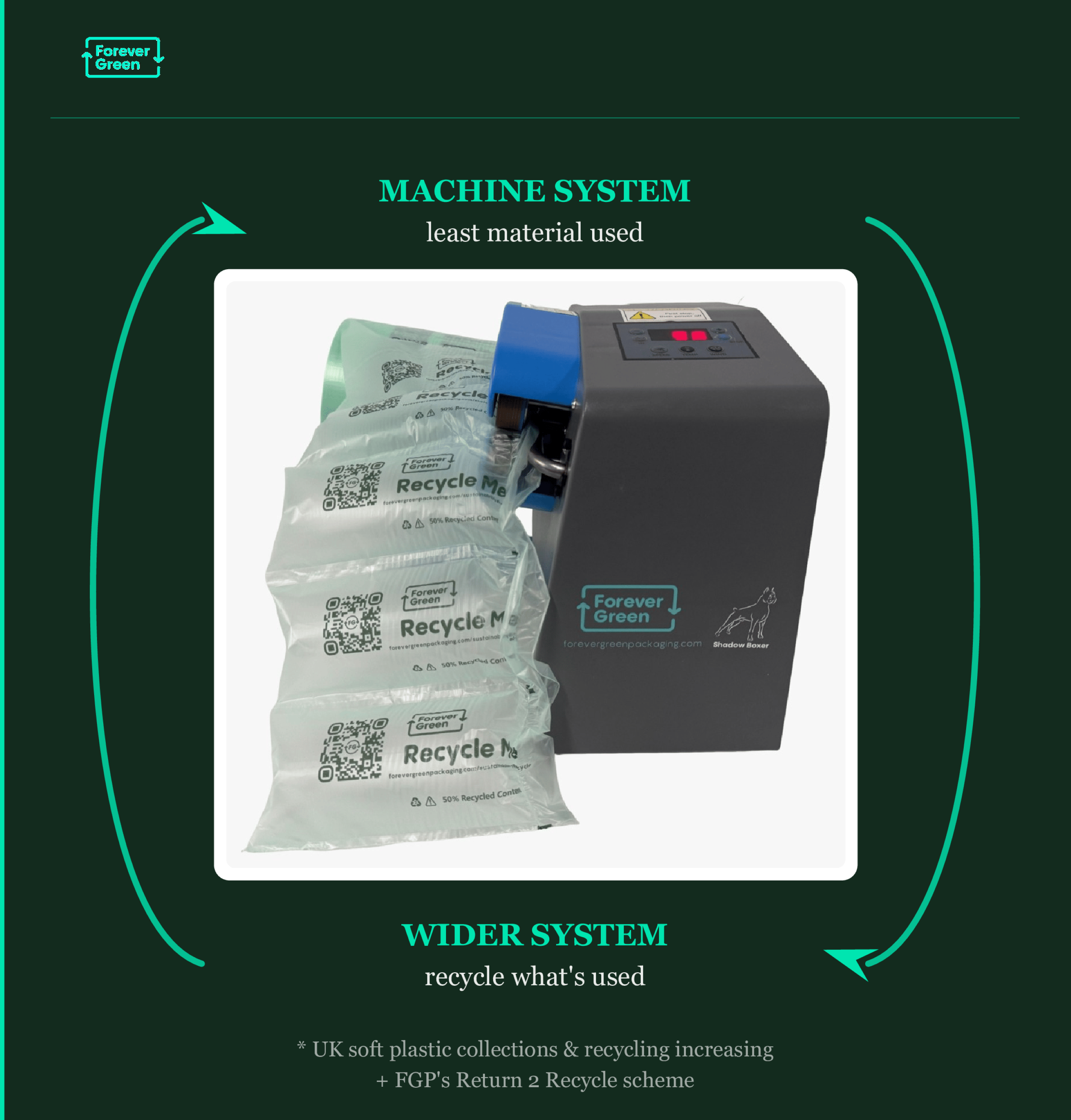
System 1 – the wider material ecosystem
This is the entire ecosystem that surrounds the material: the infrastructure for collection and recycling, the culture and behaviour of consumers and businesses with materials at end of life, the processing capacity available to handle used materials, the regulatory framework that shapes how materials are managed, and the circular economy potential of the material over multiple use cycles.
This is System 1. And it is the dimension that determines whether a material's theoretical environmental advantage is realised in practice. Often the theory of a ‘green’ sounding material evaporates in pratcie because the real-world infrastructure to support it doesn't exist. And it actually adds to environmental impact.
System 2 –the specific packaging system which produces or dispenses material
When talking systems, we also mean something more local and specific: the machines and dispensers that produce protective packaging material on demand, at the point of use, in the right type and the right amount for each job. E.g. our The Shadow Boxer Mk2 air cushion system, various paper void fill systems, and the padded paper dispenser are all systems in the operational sense.
This System 2 will be explored in depth in this series: how the right packaging system, operating with the right material, offering various sizes & styles, can deliver protective, operational, environmental and cost-saving outcomes that basic materials can’t.
These two macro and micro system meanings complement each other and help us understand what separates a genuinely sustainable and optimised packaging operation from one that is merely using the right-sounding material.
Revising the material science conclusions
It helps to set the scene with the material science in Series A, which established PE film as the lowest-impact protective packaging material for most applications, even under worst-case conditions: no recycled content, no recycling, straight to general waste.
The studies were mostly measuring material properties. They were not measuring whether the right amount of material was being used per pack, whether packaging was consistent from one operative to the next, or the cost of the damaged goods that resulted from inadequate packaging.
These are system questions which multiply the material environmental case and makes it easily actionable.
Series A also concluded the right material is the one which primarily protects the product, as the environmental and economic impacts of damages far outweigh material selection. Then it’s a case of using the lowest impact material to achieve this protection, and using as little of it as possible.
E.g. for most e-commerce applications, PE air cushion film is the right material. But for heavy, dense, industrial items where compressive load is the primary challenge, padded paper is the right material. The science supports a case-by-case approach, and so does FGP's product range.
The material ecosystem — System 1
The LCA science establishes which material has the lowest environmental impact in production, use and end-of-life. Here we’ll focus on the reality of end-of-life scenarios for various materials, which either enhance, maintain, or undermine the results the studies assume.
As we know, the studies assume no recycling and general waste for PE films. However, recycling for this material is happening and its end-of-life trajectory is improving. Soft plastic collections are now available at all major UK supermarkets. The Simpler Recycling legislation, though delayed to April 2030, sets a mandated direction for curbside soft plastic collection across all English households and businesses. Our Return 2 Recycle scheme provides a confirmed circular outcome for every FGP customer who participates today, without waiting for the broader infrastructure to catch up.
It is worth contrasting this with compostable packaging. This attracts significant interest and is often positioned as the most environmentally progressive option available. But the reality is more complicated. Compostable packaging is designed to breakdown in industrial composting conditions: specific temperatures, humidity, and microbial activity sustained over a controlled period. The United Kingdom, and most countries, has no industrial composting infrastructure at scale, and subsequently very few, if any, compostable collections. The vast majority of compostable packaging disposed of in the UK ends up in one of three places: 1) general waste, where it goes to landfill or incineration without composting; 2) the wrong recycling stream, where it contaminates otherwise recyclable batches meaning entire loads to be rejected; or 3) as litter, where its marketing means some people assume it’s harmless to the environment. But it is, like any material. The last two outcomes add considerably to the waste problem. Compostable packaging that does not reach industrial composting conditions does not compost. There are some ‘home compost’ certified materials, but again they need a certain and unlikely set of sustained conditions to degrade. You’ll know this, if like me you’ve tested it and seen them stick around so long you end up putting it in general waste. It’s also worth noting only 5% of UK households have a compost. And these materials are intensive in production, and very costly. But this is not to say there’s not a place for them when the wider system/ infrastructure improves.
This is the gap between a material's potential and the system it belongs to, and why System 1 matters as much as the material itself.
PE film's practical performance is not dependent on infrastructure that doesn't yet exist. It is already the lowest-impact material even if not recycled. Yet it is already accepted in growing soft plastic collection streams. And it is recyclable through FGP’s Return 2 Recycle, with clear instructions printed on the film.
The packaging system — System 2
If System 1 determines the end-of-life potential of a material, System 2 determines how well that material is used in the first place.
A packaging operation without a system, such as one using loose fill bags of peanuts, pre-made bubble wrap, or manual paper, is an operation where the amount of material used per pack varies massively. Some parcels will be over-filled, some correctly filled, and some under-filled, which generates damages.
This variability has three costs. There is the commercial cost: damaged goods, returns, replacements, customer service. There is the environmental cost: wasted material in over-filled parcels, remanufacturing and transport emissions from damaged goods. And there is the operational cost: the time and labour that variable packing consumes.
A packaging system addresses all three. The machine produces a consistent output, which can be standardised per pack, and adjusted for various pack needs. Protection is predictable and repeatable across every parcel packed, regardless of volume, time pressure, or operative experience.
And the system produces only what’s needed, when it’s needed, from usually a compact roll of film or block of paper. These ship and store at a fraction of the number of deliveries or space needed compared to equivalent volumes of pre-made packaging, like bubble or peanuts. This is especially the case for rolls of air cushion films, because the majority of the finished product is Air, after being inflated on-site by the machine. Overall, the material footprint of every pack is automatically optimised.
This is the compounding argument at the heart of Series B: a packaging system ensures 1) less material used 2) optimum protection/ less damages 3) less deliveries & saved space and 4) and saved time. The environmental, commercial and reputational benefits of a system aggregate with every parcel packed.
What Series B will cover
The remaining pieces in this series will explore each of the operational advantages in turn. How one roll of air cushion film replaces six bags of packing peanuts — and what that means for storage, deliveries, and cost. How on-demand production eliminates the environmental waste of overstocked packaging. How one machine producing multiple sizes of material reduces inventory complexity and operational friction. How best-fit materials reduce damages. How consistent, right-sized packing reduces freight costs by reducing pack weight, size and volume. How systems improve pack times and productivity.
And how FGP's simple, reliable and affordable machines remove the usual obstacles to a system, so businesses of all sizes can enjoy their benefits.
The material science was the foundation. The system is where it becomes multiplied, practical, easy to apply, and super helpful to your business.
This piece opens Series B of the Forever Green Packaging content series. Series A — pieces 1–6 — covered the material science case for HDPE air cushion film. Series B explores the operational and environmental case for packaging systems.
